
Why Tired People Need a Campfire More Than Another Weekend Indoors
There is a particular kind of tiredness that sleep alone does not fix.
It is not always dramatic. Sometimes it looks quite normal from the outside. You go through the week, answer what needs answering, move from one task to the next, and arrive at the weekend thinking rest is finally within reach. Yet somehow by Sunday evening you do not feel restored even with just staying at home, sleeping more than usual — but something in you still feels crowded, unfinished, overstimulated, or quietly worn thin.
Many people know this feeling well.
It is the fatigue of too much input. Too much screen-light, too much fragmented attention, too much indoor air, too much low-level urgency. It is the kind of exhaustion that can survive a full night’s sleep because it is not only physical. It is mental, sensory, and emotional. It comes from living in environments that keep the mind constantly partially engaged, even when the body is technically at rest.
This is one reason a campfire can do something an ordinary weekend indoors often cannot.
Not because fire is magical in a dramatic sense, and not because camping is some grand cure for modern life, but because being outdoors — and especially gathering around a fire in the evening — changes the rhythm of attention. It gives the mind fewer places to scatter. It gives the body a more natural pace to follow. It gives conversation less pressure. It gives silence somewhere to land.
In Sri Lanka, where outdoor evenings hold soft cooling air, steady rise of insect song, the darkening silhouettes of trees, the sense of night arriving as a living atmosphere - a deep shift than a switch being flipped.
For tired people, the campfire is not just a pleasant detail. Sometimes it is the first thing in a long time that lets them properly unclench.
What this article will help you understand
If you only have a few minutes, here is the heart of it:
A weekend indoors can help you stop, but it does not always help you truly reset. Many indoor environments still keep your attention divided and your nervous system lightly activated. Camping, especially in the slower hours around a fire, changes that. It narrows your focus, softens your pace, reduces stimulation, and makes room for a different kind of rest.
You do not need to be exhausted to benefit from it. But if you are carrying the kind of tiredness that lingers beneath sleep, a campfire often meets it differently than a couch, a screen, or another quiet evening inside.
This is not because the outdoors are automatically superior in every way. It is because the right outdoor setting removes certain pressures and restores certain human rhythms that many of us rarely meet anymore.
And sometimes, what tired people need most is not entertainment, productivity, or even more comfort — but warmth, darkness, simplicity, and enough stillness to let their minds return to one place at a time.
Why “resting” indoors does not always feel like rest
Many of us have been taught to think of rest as the absence of activity.
No meetings. No commute. No obligations. No getting dressed to go anywhere.
In theory, this should be enough. Sometimes it is. But very often, what we call rest in modern life is not actually rest — it is simply a softer version of the same stimulation.
You stay home, but your phone remains nearby. You sit down, but your attention keeps shifting. You tell yourself you are relaxing, but your mind is still scrolling, comparing, checking, deciding, replying, half-listening, half-thinking ahead. Even leisure becomes layered with noise. The body may be still, but the mind is not.
This is one of the quiet difficulties of urban life. The spaces we call restful are often still built around interruption. Light remains artificial. Sound remains constant.
Devices keep offering input. Indoor life can be comfortable, but it is not always truly settling. A great many tired people are not starved of comfort. They are starved of undivided attention.
This is why a free weekend indoors can still leave you strangely unchanged. You may have avoided strain, but you may not have reached restoration.
The nervous system does not always calm down simply because the calendar opens up. Sometimes it needs a different environment altogether.
A campfire gives your attention somewhere simple to rest
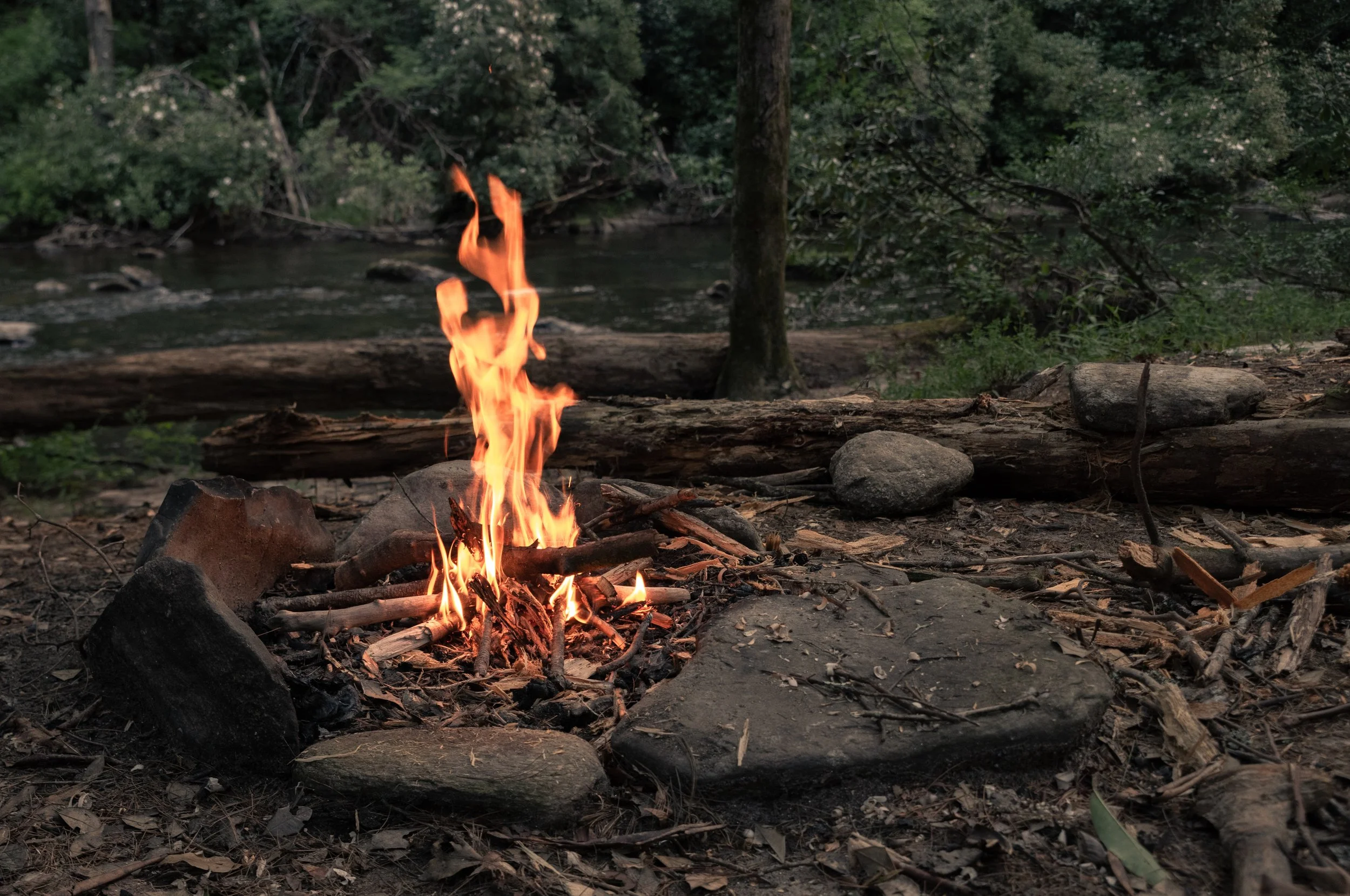
One of the quiet powers of a campfire is that it gives your attention one small, living thing to follow.
You do not need to “do” anything with it. You do not need to achieve anything around it. You do not need to improve yourself beside it.
It is simply there: warmth, light, movement, sound. It flickers, settles, rises, and shifts in ways that are interesting enough to hold the mind, but not demanding enough to scatter it. This matters more than it seems.
So much of modern fatigue comes from attention being pulled in too many directions at once. A fire does the opposite. It gathers focus. It narrows the field gently.
It gives the eyes something soft to rest on. It reduces the impulse to keep reaching for another layer of input. Because it is shared, it does something socially helpful too.
People do not usually sit around a campfire performing the way they might around a formal dinner table or in a brightly lit indoor room. The atmosphere is looser.
The pressure drops. Conversation stretches out. Silence becomes more natural. You can speak, or not. Either way, the space still feels full.
There is a reason fire has remained a gathering point across cultures for so long. Not only because it provides warmth, but because it changes the shape of human presence around it.
Sri Lanka too holds an old familiarity to this — evenings gathering around warmth, shared food, dim light, conversation that unfolds more slowly once the day’s work has softened. A campfire can awaken something that feels both simple and deeply remembered.
Outdoors, your body starts following a different rhythm
Rest is not only about what you stop doing. It is also about what rhythm replaces it.
When you are outdoors, especially in a well-paced camp environment, the body often begins to sync with more natural cues. Light changes gradually. Evening arrives visibly. Temperature shifts can be felt, not just measured. Hunger becomes cleaner. Sleepiness arrives differently. Morning does not begin with alerts, but with birds, light, and air.
This shift can feel surprisingly relieving.
In indoor life, many of the body’s signals are constantly overridden. Bright artificial light extends the day. Screens pull attention long after the mind is tired. Meals happen out of schedule, out of stress, or out of habit rather than appetite. Even fatigue becomes easy to miss until it becomes too heavy to ignore.
Camping, by contrast, often brings the body back into clearer conversation with its surroundings.
You notice when the evening cools. You feel hunger after movement and fresh air. You become aware of tiredness as the night settles.
You wake not because the alarm says you must, but because the world around you has begun again.
None of this needs to be idealized. You do not become a completely different person overnight. But even a short time outdoors can remind the body of rhythms it understands more easily than many modern ones.
For tired people, this matters. Because sometimes the deepest relief is not in doing less, It is in being brought back into a pace that makes more sense.
In Sri Lanka, the evening itself does part of the work
Not all outdoor evenings feel the same. Sri Lanka has a particular way of moving from day into night, and it shapes the experience of camp in ways first-time campers often do not expect. Depending on where you are, the heat loosens slowly or all at once. The sky dims under tree cover. Insects begin their evening music. The air carries the scent of dry leaves, damp soil, nearby water, or woodsmoke. Daylight does not simply disappear — it withdraws in layers.
When you are in the city, darkness is often obscured. The night arrives, but never fully. Light pollution, traffic, screens, indoor brightness — all of it keeps the nervous system slightly suspended. Outdoors, especially in wilder parts of Sri Lanka, night feels more complete. It has texture. It asks something quieter of you.
This is part of what makes a campfire so effective here. The fire is not competing with a dozen other light sources. It becomes the center naturally. Around it, the world feels wider and simpler at the same time. The mind does not need to keep switching contexts. It can stay where it is.
There is also something very old in this. In many parts of Sri Lankan life, evening has traditionally been a time of gathering, softening, and slowing — after work, after heat, after movement. Fire, dim light, shared conversation, listening to the night: these are not foreign human experiences. They are older than our current pace of living.
Perhaps that is part of why camp can feel restorative so quickly. Not because it introduces something unnatural and extraordinary, but because it returns us — however briefly — to a way of winding down that the body and mind still recognize.
Why conversation changes around a fire
One of the most noticeable things about a good campfire is not the fire itself. It is what happens to people around it. Conversation changes. Not always dramatically. Sometimes it just becomes more real.
People who were speaking in practical, surface-level ways earlier in the day often begin to soften. The need to fill every silence fades. Jokes land more easily.
Thoughts become less polished. Stories rise naturally. Even when the conversation stays light, it often feels less strained, less performed.
Part of this is the environment. There are fewer competing demands. There is no television talking over the room. No one is being interrupted by a dozen household tasks. No one is simultaneously consuming three other streams of information. The mind is no longer defending itself from constant input, so it no longer needs to speak from that place either. Part of it is the work that came before.
At a good camp, by the time people are sitting around a fire, they have already done something together. They may have helped set up, carried something, made tea, sorted gear, or simply adjusted to a shared outdoor rhythm. That matters. People often open more easily after they have participated side by side in something small and real.
There is a reason so many meaningful conversations happen not in formal settings, but after effort has ended — while cooking, walking, sitting, waiting, or watching firelight.
The best campfire conversations rarely feel scheduled. They arrive because the conditions finally allow them to.
Silence feels better outdoors
Tired people are often more depleted by noise than they realize.
And not only obvious noise. Not just traffic, calls, or crowded rooms. There is also the subtler noise of constant low-level engagement: background media, digital notifications, indoor hums, the visual noise of clutter, the mental noise of unfinished thought.
Even quiet indoor spaces are often not truly quiet in the way the mind needs.
Outdoors, silence is different. It is not the absence of life. It is the absence of human-made pressure.
Around a campfire, silence rarely feels awkward when the environment is doing some of the holding. You hear insects. Wind. A kettle. The shifting of someone settling into a chair. A branch moving. The fire itself. These sounds do not demand interpretation in the same exhausting way as urban noise. They simply belong.
This is one reason people often feel less pressure to keep talking outdoors. The space does not feel empty when no one is filling it. For someone who is worn out, this can be deeply relieving.
To sit in good company without needing to entertain, explain, respond, or perform — and still feel connected — is a form of rest many people do not get often enough.
Camp restores something more human than convenience
Convenience is useful. Comfort is useful. Indoor life exists for good reasons. But not every kind of comfort nourishes the same part of us.
A weekend indoors often offers softness, ease, and control. Camping offers something else: directness. Simplicity. A slightly more elemental kind of comfort.
Warmth you can feel as warmth. Darkness that is actually dark. Food that tastes earned. Conversation that arrives without too much handling. A body that starts following light and temperature again. A mind with fewer surfaces to bounce off.
For tired people, this can feel unexpectedly honest. There is less to hide behind. But there is also less to manage.
You are not trying to optimize rest. You are simply letting a more grounded environment do some of the work. And sometimes, that is exactly why it helps.
This is also why camping does not need to be extreme to be restorative. You do not need a dramatic expedition, a grand wilderness narrative, or some performance of toughness. Very often, what heals is not intensity. It is enough simplicity for the nervous system to loosen its grip.
A campfire becomes important not because it is spectacular, but because it quietly gathers many of these qualities into one place:
warmth, focus, slowness, low light, shared presence, and permission to stop scattering.
What people often get wrong
When people feel depleted, they often assume the answer is simply “more rest.”
But a few common misunderstandings get in the way:
1. Mistaking comfort for restoration
Something can be comfortable without being restorative. Soft seating and indoor convenience are not always the same as nervous system relief.
2. Thinking rest means passive consumption
Many people spend their weekends “resting” by consuming more content, more noise, and more stimulation. This can feel pleasant without being truly replenishing.
3. Underestimating atmosphere
Where you rest matters. The setting changes the quality of the rest itself.
4. Assuming camping is only for energetic people
In reality, well-paced camping can be deeply beneficial for tired people precisely because it slows the body and steadies the mind.
5. Expecting a dramatic transformation
The change is often subtle at first. You may simply notice that your breathing is softer, your mind is less noisy, or your evening feels less fractured.
If you are feeling burnt out
If you are carrying the kind of tiredness that follows you through ordinary weekends, it may be worth asking a different question.
Not how can I rest harder?
But what kind of environment actually helps me settle?
For many people, the answer is not more entertainment, more scrolling, or even more time indoors. It is a place with fewer demands, gentler light, cleaner air, and a more natural pace. A place where the body can feel evening happen. A place where your attention does not have to keep defending itself.
That is part of what makes camping so quietly powerful.
Not because it solves everything. Not because every trip is instantly profound. But because it makes a simpler form of restoration available again.
And for many tired people, that is enough to matter a great deal.
A gentle closing thought
Sometimes what we call exhaustion is not only a lack of sleep.
Sometimes it is a lack of darkness.
A lack of quiet.
A lack of one thing to look at instead of ten.
A lack of warmth that gathers people instead of separating them.
A lack of evenings that end slowly enough for the mind to catch up with the body.
This is why a campfire can feel like more than a pleasant outdoor detail.
For a tired person, it can be the first true exhale of the week.
Not because it asks nothing of you — but because it asks so much less than the world you have just stepped out of.
Sometimes, that small difference is exactly what lets you begin to feel restored.