
Camping in Sri Lanka for First-Timers: What It Actually Feels Like
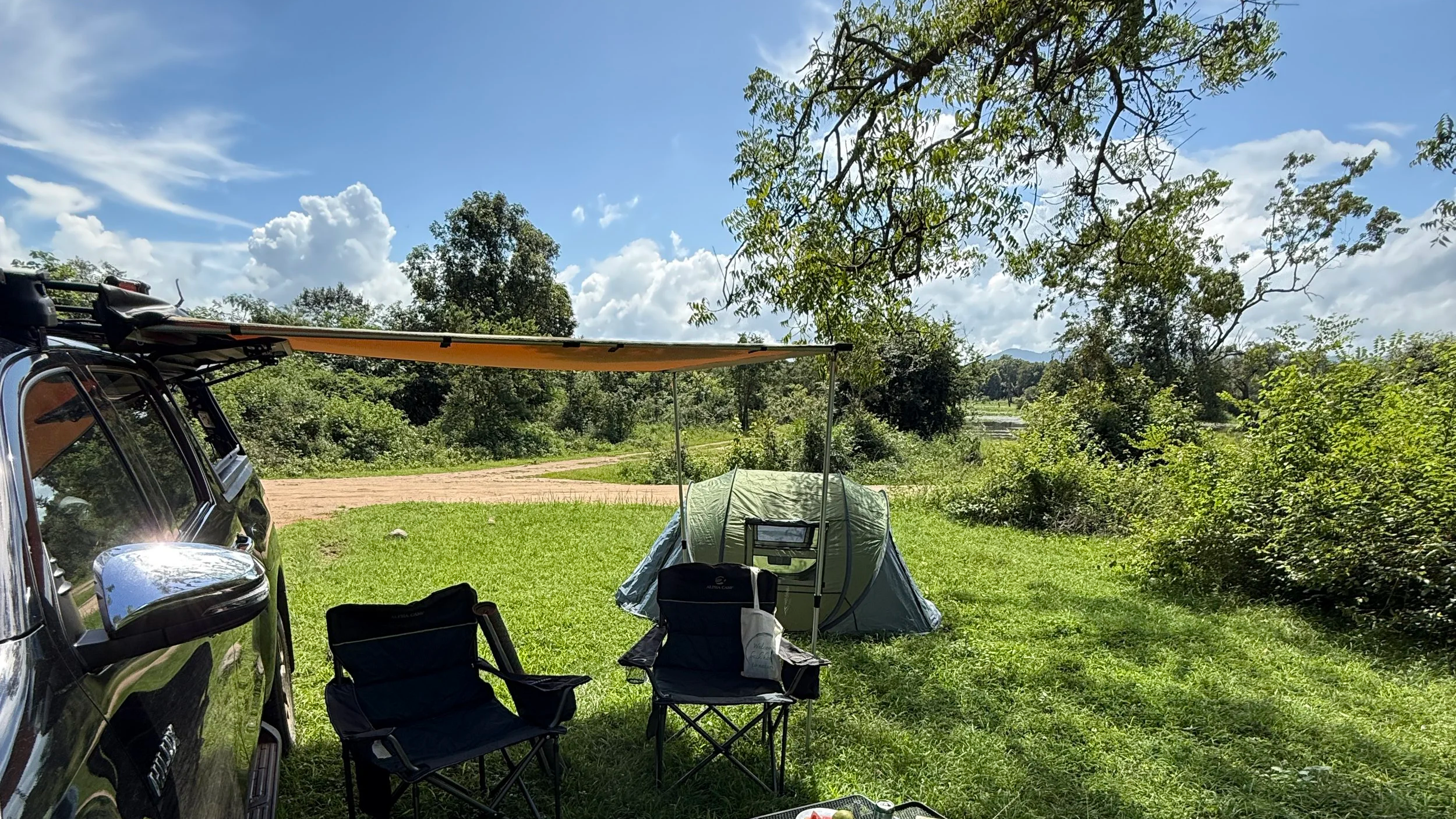
You can read a hundred packing lists, watch a dozen camp videos, and still have no real idea what camping in Sri Lanka feels like until you arrive.
For many first-time campers, the idea of camping lives somewhere between romance and uncertainty.
There is the beautiful part: trees, firelight, stars, birdsong, tea in the morning.
Then there is the anxious part:
Will I be comfortable?
Will I be able to sleep?
How do I use the bathroom?
What if I don’t know what to do?
What if the wild feels too wild?
These questions are normal. In fact, they are often the first signs that you are about to step into something real.
Camping in Sri Lanka is not simply a change of accommodation. It is a change of rhythm. It asks you to leave behind the neat, controlled habits of indoor life and settle,
even briefly, into a more grounded relationship with light, weather, sound, appetite, and time. For some people, this feels thrilling from the first moment.
For others, it takes a few hours. For almost everyone, something shifts by the first morning.
If this is your first time, this guide is here to offer an honest picture of what the experience actually feels like,
Not the dramatic version, not the polished fantasy, but the real one.
What this article will help you understand
If you only have a few minutes, here is the short version:
Camping in Sri Lanka can feel unfamiliar at first, especially if you are used to city life, private routines, and predictable comfort. The first hour may feel slightly awkward.
The first evening may feel new and heightened. The first night may feel different. But once you settle into the rhythm of camp — setting up, sharing space, eating outdoors, listening to the night, waking with the morning — what first felt unusual often begins to feel deeply human.
You do not need to arrive as an “outdoors person.” You do not need to know everything. You do not need to perform competently.
You only need to come prepared enough, stay open enough, and allow the place enough time to stop feeling foreign.
In Sri Lanka, that process is especially beautiful. The island has a way of making the outdoors feel alive very quickly — through the warmth of the late afternoon,
the chorus of insects after dusk, the scent of earth, the changing sky, the first bird calls at dawn.
Even when camp feels simple, it rarely feels empty.
The idea of camping is often harder than the reality
Before their first trip, most people imagine camping in extremes.
They imagine either a picture-perfect wilderness fantasy where everything is glowing and cinematic, or a mildly uncomfortable ordeal where they are hot, confused, and trying not to embarrass themselves. The truth is usually much gentler than either.
In reality, a good camping experience is made of small things done well.
It is arriving while there is still light. It is being shown where things go. It is learning that camp has a natural flow. It is realizing that everyone else is also adjusting from road-brain to camp-brain. It is understanding that no one is expecting you to be a hardened explorer. It is watching a temporary space slowly become livable, warm, and welcoming.
This is one of the first surprises for new campers: camp does not appear fully formed. It becomes itself through a sequence of simple acts.
A tent goes up. A table is placed. Water is sorted. Bags are set down. Tea appears. Someone checks the light. Someone helps with the fire. Someone laughs because they were not sure where to stand, and now they are already part of something.
That first transition matters more than people realize.
Arrival is the real beginning
The road ends, or at least changes. The air feels different. Even before camp is fully visible, something shifts.
In Sri Lanka, that shift can be immediate. The light may grow warmer and more golden as the afternoon leans toward evening. The wind may carry the smell of dry grass, damp earth, leaves, or water, depending on where you are. There is often a sense that the space around you has become larger, even when you are surrounded by trees.
This is the moment when many first-time campers become quietly alert. Not panicked. Just aware.
Outdoors, especially in a quieter setting, you begin meeting the place almost at once. The sounds stand out. The silence between them stands out too. You become conscious of where the sun is, what the ground feels like underfoot, where your body is in relation to everything else. That heightened awareness can feel unusual at first, but it is not a bad sign. It is simply your attention waking up.
For international travelers, this may be one of the first deeply tactile experiences of Sri Lanka beyond roads, hotels, and viewpoints. For locals from the city, it can feel like reacquainting yourself with something older and more familiar than you expected — an island memory still alive beneath modern routine.
There is an old Sri Lankan instinct, especially in rural life, of reading a place before fully settling into it: feeling the wind, noticing the trees, hearing birds, sensing weather through atmosphere rather than forecast. First-time campers may not have words for it, but they often begin doing this naturally.
The first hour can feel awkward — and that is perfectly normal
The first hour in camp is often the least elegant and the most important. The hour when bags are still bags, not yet belongings arranged in useful places. You may not know where to stand, where to put your hands, or what to do first.
If you are used to arriving somewhere and being immediately “served” by a fully prepared environment, camp can feel slightly unusual because it asks for a different kind of presence. But this is where confidence begins.
In a good camp, the first hour is not about getting everything perfect. It is about helping the place come together. That may mean joining in with very simple tasks, watching and learning, asking where things go, or even beginning to understand the flow.
This matters because participation reduces uncertainty. The moment you help with something, even if its a small task, the experience starts feeling less like an unknown environment and more like a shared one. You are no longer standing outside the moment. You are in it.
This is also where many first-time campers realize they do not need to “know camping” in order to belong there. They only need to be willing to enter the rhythm.
And the rhythm itself is usually simpler than expected. Camp is not a performance. It is not a test. It is a temporary way of living together outdoors.
As evening comes, the campsite begins to make sense
There is a point, often sometime around dusk, when camp stops feeling like a setup and starts feeling like a place. This is one of the most beautiful parts of the first day.
The light softens. The practical movement of arrival begins to settle. The campsite becomes legible. You know where things are. You know where to sit. You know where the water is. You know where the fire will be. You start noticing not just the work of camp, but the atmosphere of it.
In Sri Lanka, dusk has a very particular life to it. Day creatures ease off. Night creatures begin. Insects start their evening chorus. The air may cool slightly, depending on season and location. Smoke, if there is a fire going, sits in the air with a kind of ancient familiarity. The sky shifts tone. Trees become silhouettes. Voices become softer without anyone deciding they should. This is often the moment when first-time nerves start to dissolve.
There is food being prepared, or shared. There is warmth. There is a sense of enclosure without walls. You are outdoors, yes, but not exposed in the way you may have imagined. You are held by the structure of camp, by the people around you, by the simple intelligence of routine.
For many people, the first real feeling of ah, this is what camping is arrives here. Soaking in the ordinary beauty of a campsite that has come alive.
Food outdoors feels different
One of the quickest ways a first-time camper begins to trust the experience is through food.
There is something about eating outside — especially after movement, setup, and fresh air — that changes appetite completely. Food tends to feel more satisfying, more comforting, and somehow more memorable than it would indoors.
A hot cup of tea in cooling evening air. Something warm and simple shared after camp is set.
The smell of food mixing with earth, smoke, and leaves. These things do more than feed you. They settle you and soften the distance between people. Someone passes something across the table, checks if everyone has enough. Someone who barely spoke at the beginning of the evening is now laughing over a very ordinary thing. The structure of the meal is simple, but the feeling can be unexpectedly rich.
For first-time campers, this is often the first strong sign that camp comfort does not come from polished surfaces. It comes from rhythm, warmth, appetite, and shared presence.
The first night feels different because it is different
Let’s be honest: for many first-time campers, the first night is the part they think about most.
Will it be too noisy? Too strange? Too dark? Too unfamiliar?
The truth is that the first night often does feel different — but different is not the same as bad.
We are used to familiar walls, predictable sounds, filtered air, and the illusion that the world outside has gone quiet. In camp, you are more aware of night as a living thing. You may hear insects, leaves, fabric moving gently, a distant call, branches shifting in wind, the subtle sounds of other people settling in. For someone new to camping, this can feel like a lot at first, simply because it is not your usual backdrop.
But something important happens when you stay with it long enough: what first felt “loud” often becomes textured. What felt unfamiliar starts becoming natural. Your mind stops trying to classify everything and begins to accept that the night is active, not empty. This is where many first-time campers learn a quiet but valuable lesson: not every unfamiliar sound requires concern.
Most of what you notice on a first night is simply the world being itself. That said, no one needs to pretend the first night is always instantly comfortable. Sometimes you take time to settle. Sometimes you wake a little more than usual. Sometimes your body is still in transition. That is normal too. The goal of the first night is not perfect sleep. It is an acquaintance. You are learning how the night feels in this place. And the place, in its own way, is becoming less foreign to you.
The first morning is when many people truly arrive
If the first evening introduces you to camp, the first morning often wins you over.
There is a quality to waking outdoors that feels very different from waking in the city. The light arrives gradually. The air is often cooler and clearer. Birds begin before people do. There is no abrupt transition from sealed room to busy day. Instead, the morning reveals itself in layers. This can feel unexpectedly gentle.
Even people who thought they did not sleep perfectly often find that the morning feels better than expected. Their senses feel clearer. Their mood is lighter. Their body feels more present. The anxieties of the previous day have usually dropped by now, because the unknown has already become partially known.
You know what the night sounded like. You know where the tent zip is. You know where to walk. You know how camp moves - with that comes an enormous release.
This is why so many first-time campers change after the first morning. Whatever uncertainty they brought with them now has something real to stand against. They are no longer imagining the experience. They are in it. There is also something quietly beautiful in the simple rituals of camp morning. A hot drink. The soft warmth of first light. The slow return of conversation. The sense that the day begins not in urgency, but in attention.
Sri Lanka does mornings beautifully. Even when they are simple, they can feel abundant.

Mornings at Yala National Park
What first-time campers often get wrong
Most first-time campers do not struggle because they are incapable. They struggle because they carry the wrong expectations. A few of the most common mistakes you can be aware of during your first camp experience.
1. Expecting instant comfort
Camp comfort often builds over a few hours. It is something you enter, not something you receive all at once.
2. Thinking you need to “know what you’re doing”
You do not need to arrive as an expert. You need to arrive willing to learn the flow.
3. Interpreting unfamiliarity as a problem
New sounds, new textures, new rhythms — these are not signs that something is wrong. They are signs that you are somewhere real.
4. Trying to compare everything to a hotel
Camping is not lesser comfort. It is a different kind of comfort, one built from atmosphere, participation, and place.
5. Rushing the adjustment
Some people need half an hour. Some need a full evening. Some need the first morning. Give yourself the time.
First time camping?
If this is your first camp, here is what matters most:
- Come with practical expectations, not fear
- Pack simply and sensibly
- Ask questions when unsure
- Help with small tasks when invited
- Allow yourself time to adjust
- Do not judge the whole experience by the first 20 minutes
You are not failing if the outdoors feels unfamiliar at first. You are just in the early stage of meeting it.
What stays with people afterward
Ask people what they remember most from their first real camping experience, and it is rarely one big dramatic moment. Usually, it is smaller than that.
The way the light changed in the evening.
The first cup of tea after waking up.
The surprising comfort of shared space.
The sound of the night becoming less strange.
The realization that they did not need nearly as much as they thought.
The feeling that, somewhere between arrival and morning, they became quieter inside.
This is part of what makes camping in Sri Lanka so special. The island allows nature to come close quickly.
Not always in grand spectacle, but in atmosphere, texture, sound, scent, and rhythm. Even a simple camp can feel deeply alive. That aliveness tends to stay with people.
A gentle closing thought
You do not need to be rugged to begin. You do not need to be fearless.
You do not need to already belong to the outdoors in some polished, practiced way.
For most people, camping begins much more simply than that.
It begins with arriving a little unsure.
Helping with something small.
Eating when the air changes.
Listening to a night that feels different.
Waking to a morning that feels clearer than expected.
Somewhere in that quiet progression, the wild stops feeling like “out there” and starts feeling, if only briefly, like a place you can be.
That is often all it takes to begin.