
Why Children Remember Campsites More Than Hotels
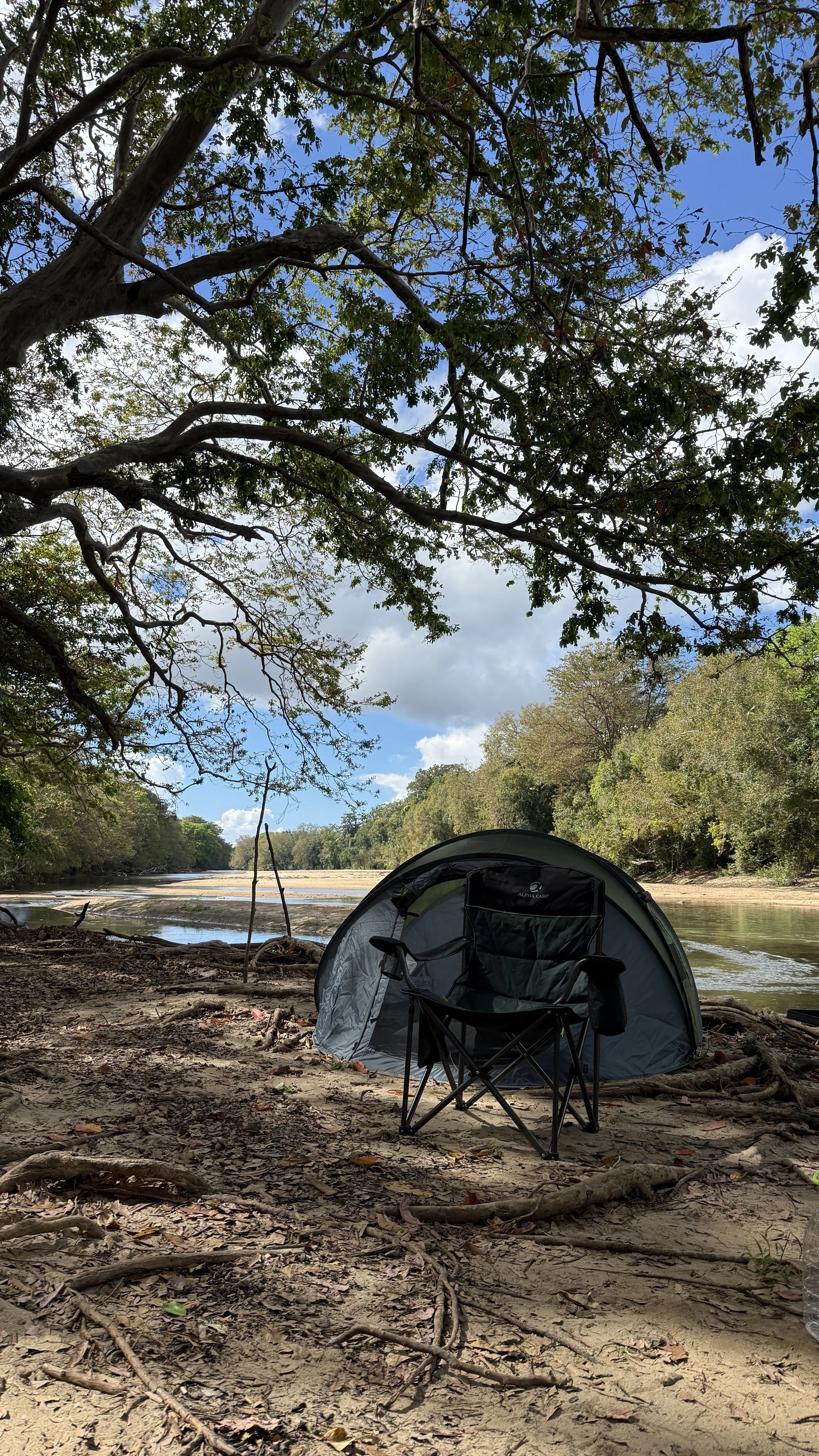
Ask an adult about a hotel, and they may remember the room, the breakfast, the convenience, the polished ease of it all.
Ask a child about a campsite, and they will often remember something entirely different.
A torch held under a blanket of darkness.
The sound of insects beginning all at once.
A cup in their hands while the air cools.
Mud on their feet.
A bird they could hear but never quite see.
Helping carry something important.
A tent becoming, somehow, the most interesting place in the world for one night.
This is one of the quiet truths of family camping:
children often remember campsites more deeply than they remember comfort.
Not because camps are always easier. Not because they are smoother, cleaner, or more predictable. But because they are richer in the kinds of things children actually build memory around: novelty, participation, sensory detail, shared effort, open-ended curiosity, and the feeling that something real is happening around them.
Hotels are designed to reduce friction. That has its place. They are convenient, contained, and made to feel easy. But convenience is not always what children remember most. Very often, children remember what asked them to notice, to feel, to help, to adapt, and to be present.
And in Sri Lanka, where the outdoors tend to feel alive very quickly — through birds, rain, dusk, earth, wind, leaves, firelight, and the simple closeness of the natural world — campsites can become especially vivid in a child’s memory.
A campsite does not only host a family.
It asks the family to inhabit a place together.
That difference matters.
Because children rarely build their strongest memories from being passively comfortable.
They build them from being meaningfully inside something.
What this article will help you understand
If you only have a few minutes, here is the heart of it:
Children often remember campsites more than hotels because camps offer the kinds of experiences that imprint strongly: sensory richness, small challenges, meaningful participation, shared family rhythm, and a direct relationship with the outdoors. Camps feel more alive, and because of that, they often stay with children more deeply.
What children tend to remember most is not perfection.
It is:
Doing something real
Noticing something new
Feeling part of the life of the place
Being close to their family in a shared rhythm
Experiencing ordinary things in a more vivid setting
A child may forget a polished room very quickly.
But they often remember:
the smell of smoke,
the feel of the morning air,
the sound of the night,
the small job they were given,
and the way the whole experience felt different from ordinary life.
Camping creates memory not because it is luxurious,
but because it is lived.
Children remember what engages their senses
One of the strongest reasons campsites stay in children’s minds is simple:
Camping engages the senses fully.
A hotel room, however comfortable, is usually built to create controlled sameness. It is temperature-managed, visually stable, neatly contained, and designed to remove unpredictability. For adults, this can feel restful. For children, it often means much less stands out.
A campsite is the opposite.
The air changes.
The light changes.
The ground feels different underfoot.
The sounds shift by the hour.
Even simple things — drinking water, putting on shoes, walking to the shared area, zipping a tent — carry texture and context.
For children, this kind of sensory richness creates strong memory.
They remember how things felt, not just what they were told. They remember the coolness of evening after a warm day. They remember hearing the first bird before anyone else was awake. They remember the smell of wet soil after rain, the warmth of food outdoors, the movement of leaves in torchlight, the sound of distant life continuing after dark.
In Sri Lanka, this can be especially vivid. The outdoors here tend to announce themselves. They do not remain politely in the background. Birdsong, insect chorus, humidity, breeze, rain, dust, heat, shade, earth, and open sky all make themselves known. For a child, this means the environment is not just a setting. It is part of the experience itself.
And what children experience through the senses, they often remember for a very long time.
Participation creates stronger memory than passive comfort
Another reason campsites leave a deeper imprint is that children are rarely only observers there.
At a good camp, children are often given small, real ways to participate. They may help carry something. Lay out cups. Arrange a corner of the shared space. Watch the adults build the evening rhythm. Hand something over at the right moment. Learn a small rule. Help with a simple task.
These acts may seem minor to adults.
To a child, they can be central.
Participation changes the emotional shape of memory. A child who helps, even in a small way, is not simply “on the trip.” They are part of what made the trip happen. That creates ownership. It gives the experience weight. It turns a campsite from a place they were brought to into a place they helped inhabit.
Hotels rarely do this.
In a hotel, most needs are handled by systems already in place. The room exists ready-made. The child enters an environment designed for use, not for shared making. There is comfort, yes — but often much less role.
At camp, even the most ordinary task can become significant because it is embedded in real life.
This is one reason children often remember camps with such seriousness and affection. They remember what they did, not only what they were given.
And that difference is enormous.
Children remember what felt real
There is something about camping that children recognize immediately:
it is not pretending.
A campsite is not polished into perfection. It is not fully pre-arranged into a consumer experience where everything arrives with the edges already softened. It is more alive than that. It requires response. It changes with light, weather, sound, mood, and time of day. It feels real.
Children tend to respond strongly to this.
Not because they love discomfort for its own sake, but because real environments offer more to engage with. There are things to notice, things to adapt to, things to help with, things to ask about, things to feel. The world does not arrive pre-smoothed. And that gives the experience a kind of honesty.
A little wind matters.
A little rain matters.
The path to the shared area matters.
The sound outside the tent matters.
The timing of food matters.
The feeling of the place changing from daylight into dusk matters.
These things are often missing in more controlled settings, where the environment is designed not to ask much of the guest.
Children often remember campsites because campsites ask them to actually be there.
Not as an audience.
As participants.
Small challenge often builds stronger memory than ease
Parents sometimes assume that the best experience for a child is the easiest one.
But memory does not always work that way.
Children often remember not only what felt pleasant, but what felt slightly different, slightly demanding, or meaningfully new. A small challenge — when well supported — can make an experience much more memorable than perfect ease ever could.
In camping, these challenges are often quite gentle:
Sleeping somewhere unfamiliar
Hearing the night more clearly
Carrying something useful
Adjusting to mud, dust, or cooler air
Waiting a little longer for a meal
Learning where to move and where not to
Figuring out how camp works
These are not hardships in the grand sense.
They are small encounters with reality.
And when children meet them safely, calmly, and with adults who make the experience feel secure, those little challenges become part of what makes the trip stick. The child feels not only entertained, but expanded.
A hotel offers ease.
A campsite often offers growth disguised as ordinary life.
This is one reason camps can stay in memory so powerfully. They ask children, gently, to become just a little more capable than they were the day before.
The outdoors make ordinary moments feel bigger
One of the most beautiful things about camping with children is how ordinary moments begin to feel extraordinary.
Not because they are staged.
Not because they are expensive.
Not because they are rare in some dramatic sense.
But because the outdoors change the frame around them.
A simple meal becomes memorable because it is eaten outside in evening air.
A hot drink becomes special because the air has cooled and everyone has settled.
A story becomes more absorbing because it is told under dark sky.
A small task becomes important because it helps the camp function.
A short walk becomes exploratory because there is more to notice.
Children are very sensitive to this shift.
They do not always need “big” moments. They often need ordinary moments happening in a setting that feels more alive than usual. In many cases, this is exactly what a campsite offers.
And in Sri Lanka, where even simple camp conditions can be richly atmospheric — a changing dusk, the sound of rain on shelter, the first morning bird calls, the smell of earth and leaves, the glow of firelight against darkness — those ordinary moments can become especially vivid.
A campsite gives ordinary life better lighting, better sound, better texture, and more room to breathe.
Children remember that.
Campsites create stronger shared family memory
Children do not only remember the place.
They remember how the family felt in it.
This is one reason campsites often carry more emotional weight than hotels. At camp, families are usually more visibly in the same rhythm. They set up together, eat in closer proximity, move through simpler routines, and spend more time sharing space without the usual separations of indoor life. There is less scattering into separate corners, separate screens, separate schedules.
The family becomes more of a unit.
And that changes what children carry home.
A child may not later describe the trip in abstract terms like “bonding” or “presence.” But they will remember the feeling of everyone being there. Doing something together. Sitting close. Listening to the same sounds. Sharing the same weather. Being inside the same little temporary world.
Hotels can of course host family time. But they often encourage separation just as easily as togetherness: different beds, different screens, indoor distractions, cleaner boundaries between “your time” and “our time.”
Camping compresses life into something more shared.
And when that sharedness feels calm, safe, and real, it becomes one of the strongest parts of the memory.
Children often value meaning over polish
Adults are often more attached to polish than children are.
We notice what is smooth, convenient, efficient, and well-finished. We feel reassured by things working invisibly. Children, on the other hand, are often more interested in what feels meaningful than what feels polished.
A perfect room may impress an adult.
A real task may impress a child.
A neatly prepared experience may feel easy to the parent.
A slightly untidy, shared, sensory-rich experience may feel unforgettable to the child.
This is not because children do not appreciate comfort. They do. But comfort alone is not always what lodges in memory. What often stays with them is aliveness — the sense that the trip had shape, texture, unpredictability, and something they could enter with their own attention.
Camping offers this naturally.
It does not need to be made “special” in complicated ways. Its specialness often comes from the simple fact that the environment is alive and the family is more fully inside it together.
The campsite becomes a story children can retell
Another reason camps stay with children so strongly is that they come with a built-in narrative.
A hotel often fades into the background of a trip. It is the place where you stayed. But a campsite is usually part of the story itself. It has sequence. Arrival. Setup. Evening. Night sounds. Morning light. A task. A funny moment. A small discomfort. A discovery. A ritual. A change in weather.
This gives children something easier to retell.
They do not only remember “where we were.”
They remember:
what happened,
what changed,
what they did,
what they felt,
what surprised them.
In other words, the campsite becomes narrative memory, not just location memory.
And narrative memory tends to last.
This is one reason children often return from camping with a much stronger sense of the trip than adults expect. The campsite gave them not just shelter, but a story they were inside.
What people often get wrong
A few common assumptions make adults underestimate the value of camping for children:
1. Thinking children mainly remember comfort
They often remember meaning, novelty, and participation more strongly.
2. Assuming ease is always better than challenge
Small, supported challenges often create stronger confidence and memory.
3. Treating camps as less valuable because they are less polished
Children often respond more deeply to what feels real than to what feels refined.
4. Over-planning every moment
Children often remember the ordinary, unforced parts of camp most clearly.
5. Underestimating how much shared family rhythm matters
Being together in the same living pattern can become one of the deepest parts of the memory.
If you are camping with children, start here
If you want the experience to stay with your children in a meaningful way:
Let them help in small ways
Keep the structure calm and clear
Do not overfill the trip with entertainment
Allow the ordinary parts of camp to matter
Do not panic over small discomforts
Let the outdoors become part of the story
Focus less on perfection and more on presence
Children do not need a flawless version of nature. They need a real enough one.
What children often carry home from camp
Long after the trip ends, children often carry home more than parents realize.
They carry:
Sensory memory
Small pride from helping
The feeling of sleeping somewhere different
A stronger sense that the outdoors are not abstract
Family memories tied to real shared moments
The beginnings of confidence in unfamiliar spaces
And often, they carry a deeper lesson too — even if they cannot yet put words to it: that some of the best parts of life are not bought ready-made.
They are built together.
Felt fully.
Lived in with open senses.
Remembered because they were real.
A gentle closing thought
Children often remember campsites more than hotels for a very simple reason:
a campsite asks more of their attention, and gives more back to it.
More sound.
More texture.
More participation.
More shared family rhythm.
More ordinary moments made vivid by open air, changing light, and the feeling that life is happening all around them.
In Sri Lanka, where the outdoors can feel so immediately alive — through birds, dusk, rain, leaves, earth, darkness, and first light — that vividness can settle very deeply into memory.
Perhaps that is the real gift of camping with children. Not that it gives them a polished experience.
But that it gives them a real one — and real things are often what they remember longest.