
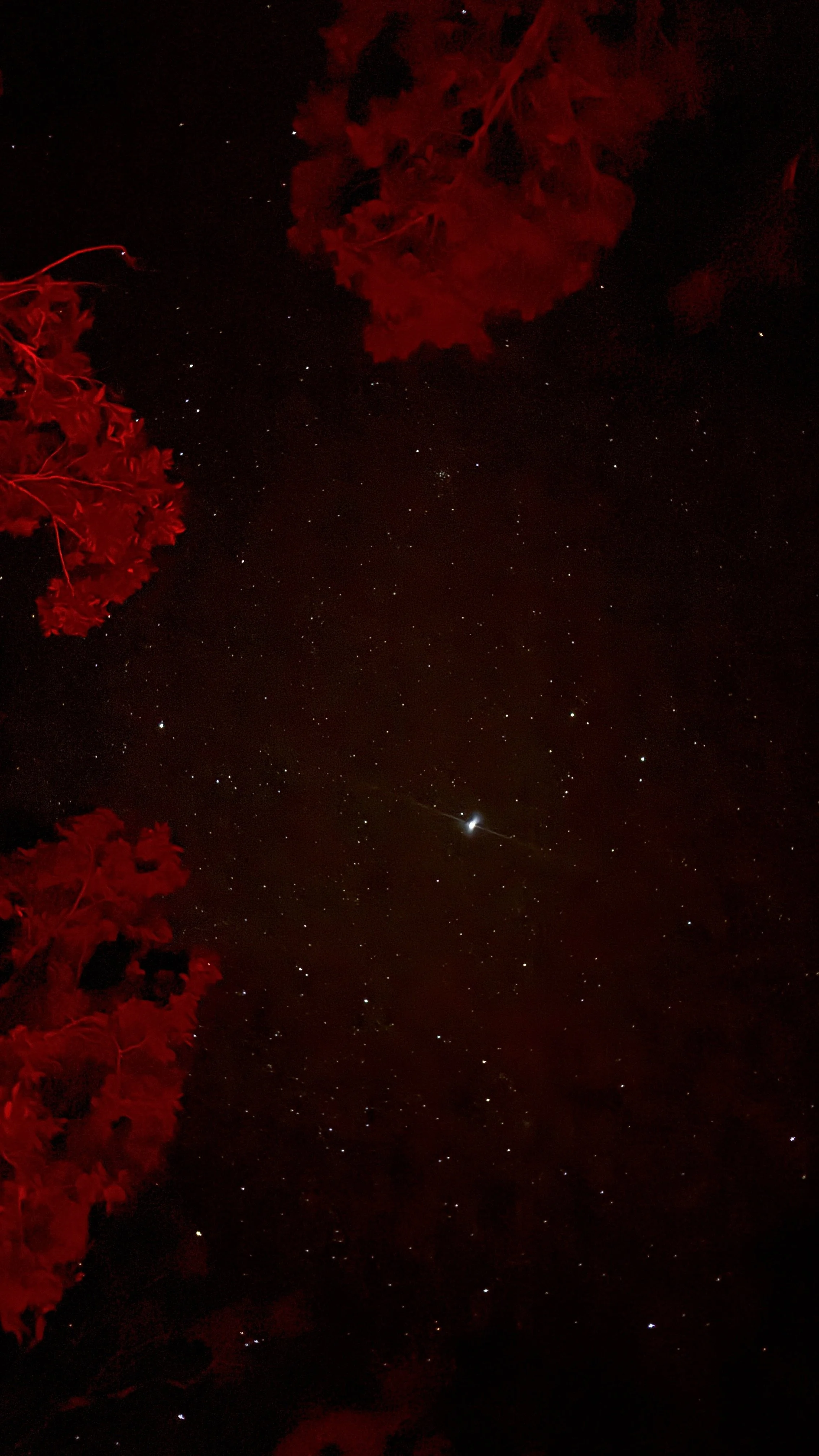
There is often a moment in camp when someone looks up and everyone else follows.
Dinner may be finished. A cup is still warm in someone's hands. The practical work of the evening has settled enough that nobody is searching for the next thing to do. Someone notices a patch of sky between the trees, and for a little while the conversation becomes quieter.
It does not always happen beneath a sky full of stars.
Sometimes there are only a few visible points of light. Sometimes clouds move across the opening. The most striking thing is simply the shape of the trees against the night, or the realization that you have spent the entire evening outdoors and are only now remembering to look above the campsite.
That small change in attention can alter the feeling of the whole place.
Until then, camp has been a world of useful distances. The bag beside the tent. The shared table. The person across the fire. The path you need to remember after dark. Looking up opens another distance, one that asks very little of you and offers no immediate task in return.
For people whose days are spent looking at screens, roads, desks, and the next thing requiring an answer, that can feel unexpectedly welcome.
In Sri Lanka, an evening outdoors may hold clouds, warm air, insect sound, a breeze moving through leaves, or a clearer opening than you expected. The sky belongs to those conditions. It is part of the living evening rather than a separate attraction waiting to begin once everything else is finished.
Learning to enjoy it does not require specialist knowledge. It begins with giving it a little of the attention that camp has already helped you recover.
What this article will help you understand
If you only have a few minutes, here is the heart of it:
The night sky can become a meaningful part of camping without a dramatic display, a telescope, or the ability to name what you see. Its value often lies in the pause it creates: looking farther, sharing quiet, and spending time with something that does not need a response from you.
What helps most is:
• Making room in the evening to look up
• Allowing the actual sky to matter, including cloud
• Keeping devices from taking over the moment
• Respecting the camp's boundaries and the people around you
• Letting curiosity remain open when you do not know the answer
There is no particular feeling you need to achieve. A few ordinary minutes beneath the sky can be enough to make the night feel more fully lived.
The sky is easy to miss even when you are outdoors
Being outside does not automatically mean paying attention to everything around you.
A camping evening has its own practical demands. There is food to share, gear to keep in order, a child looking for something, a conversation worth listening to. These are part of the pleasure of camp. They help a temporary place become a place people can inhabit together.
But attention can remain close to the ground all evening.
You may notice the fire, the meal, the tent, and the sounds beyond the light without once noticing the space above them. The sky becomes a roof you know is there, rather than something you have actually met.
This is familiar from daily life. People can walk the same road for months and rarely look beyond what helps them get through it. At camp, there is often more room to interrupt that habit.
A brief pause after a task is enough. Before reaching for the next object or beginning another conversation, look up from where you are safely settled. Notice how much sky the trees leave open. Notice whether it feels still or changing.
You are not adding another activity to the itinerary. You are allowing an existing part of the evening to enter your attention.
You do not need to know the names to begin
Some people hesitate to talk about the night sky because they feel they ought to know more about it.
They imagine that proper appreciation requires a confident explanation of every bright point overhead. Without that knowledge, they feel limited to a vague sense that it looks beautiful.
But curiosity does not need to wait for expertise.
You can notice where the open sky begins above the canopy. You can watch a cloud change the view. You can ask a question, admit you do not know, and remain interested without rushing to supply an answer.
This is familiar to anyone who has begun listening more closely to birds around camp. The first useful step is often noticing a difference. Names can deepen the experience later, but attention gives them somewhere to belong.
There is also a quiet pleasure in looking at something without immediately turning it into a test. A child asking what a light might be has already entered a worthwhile moment, even if the adult beside them cannot identify it.
If someone in the group has knowledge to share, welcome it. Let the explanation leave room for looking. The point is to become more attentive to the sky itself.
An ordinary sky can still hold an evening
It is easy to arrive with an image already in mind.
A photograph of brilliant stars. A perfectly dark clearing. A night that appears to offer everything at once. That image can quietly become the standard against which the actual evening is judged.
Then a cloud arrives, and someone says there is nothing to see.
Sometimes it is disappointing when the view you hoped for does not appear. There is no need to pretend otherwise. But disappointment becomes more limiting when it makes the rest of the night disappear too.
A cloudy evening still has movement, changing brightness, and the outline of the land beneath it. A brief opening may draw everyone's attention precisely because it was brief. A sky with little visible detail can still make the campsite feel spacious.
In Sri Lanka, where weather is already part of the texture of camping, this is a useful habit to develop. Let the evening be the starting point. If rain changes the plan, shelter and the practical needs of camp come first. The sky will still be there on another occasion.
The experience does not need to be rescued by a perfect view. Sometimes the most enjoyable thing is simply sitting outdoors long enough to notice the night changing.
Looking farther can give a crowded mind some room
Much of ordinary life takes place at distances associated with a demand.
The message needs reading. The road needs watching. The document needs finishing. Even a moment of leisure can arrive through another small rectangle held close to the face.
Looking into the night sky offers a different kind of attention.
There may be nothing to complete. You can spend time looking without arriving at a result. For someone who has been answering questions all week, that can be part of the relief.
Your concerns will not necessarily disappear. The conversation you need to have, the work waiting at home, and the practical difficulties of daily life remain real. But they may stop occupying the whole scene for a while.
You are sitting in a campsite, with other people nearby and a wider world above it. That is a different setting in which to hold a thought.
There is no obligation to turn this into a great insight. Some nights you may feel reflective. Other nights you may simply enjoy the view, feel tired, and go to bed. Either response belongs in a real camping experience.
Shared looking asks less of conversation
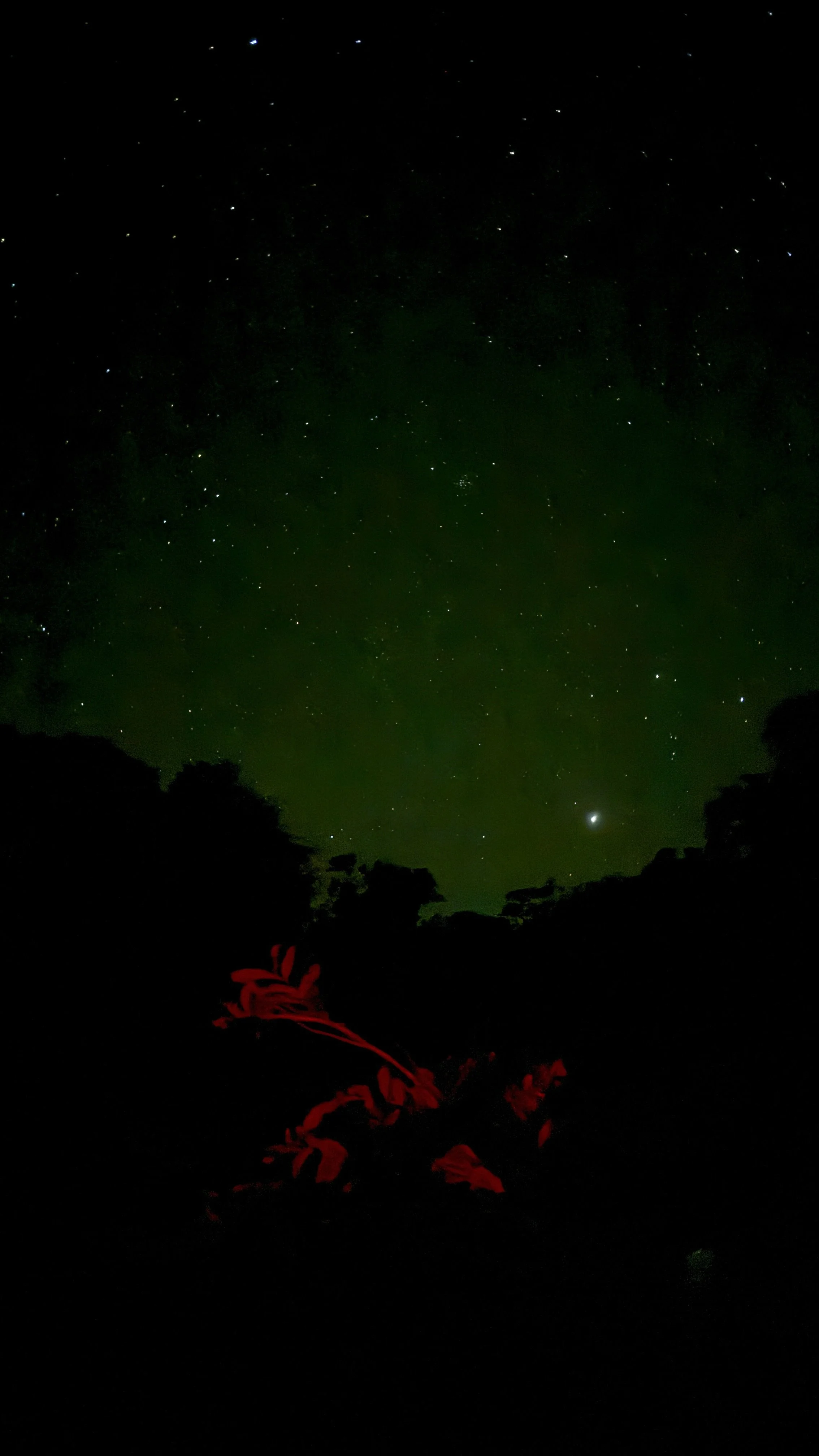
One person noticing the sky can change a group without anyone deciding to organize something.
People lean back. Someone points out the opening they were looking through. Another person asks a question. For a few minutes, the group has something to share that requires very little social effort.
This can be particularly welcome for people who enjoy company but do not always want to keep a conversation moving.
There is somewhere for everyone's attention to rest. A pause does not have to mean that the conversation has failed. Someone can speak when a thought arrives, and the others can continue looking when it passes.
The moment may become funny, thoughtful, or entirely ordinary. A child may ask the most interesting question of the evening. Someone may remember looking at the sky with a grandparent. Or nobody may say very much at all.
At a good camp, there is room for that range. Looking up together does not need to become a structured sharing exercise. Its ease is part of what makes it worth leaving unforced.
Let children keep their own questions
Children often approach the sky with an attention adults have learned to hurry past.
They may become interested in a small patch everyone else overlooked. They may ask the same question twice, or decide that the trees against the cloud are more interesting than the stars you wanted them to notice.
Follow some of that curiosity.
You do not need to deliver a lesson every time a child looks up. Ask what they have noticed. Give an honest answer when you know one, and say when you do not. A question can be something to explore later without sending everyone immediately into a phone.
Their comfort matters too. A tired child does not need to stay awake for the adult version of a meaningful moment. A short look from the shared area, followed by a familiar bedtime routine, may be the right amount.
The memory can be very small: standing beside a parent, being allowed to ask, and realizing there is more above the campsite than they had noticed before. That is plenty for one evening.
Keep the moment within the care of camp
Enjoying the sky belongs within the same thoughtful habits that make the rest of camping work.
Use an appropriate place within the agreed camp area. Keep paths clear and remain aware of the ground and people around you. There is no need to wander away in search of a more impressive view or to treat darkness as a reason to ignore the camp's guidance.
Light needs consideration as well. A torch that helps someone move safely still has a purpose. A beam swept repeatedly across faces or sleeping tents creates a different effect. Use what is needed with care, and respect other people's rest.
These are modest choices, but they protect the ease of the evening. A quiet group looking up should remain part of the camp's shared life, rather than becoming a disturbance to everyone who has already settled.
The same respect extends beyond the group. Leave wildlife alone and let the surrounding place keep its own nighttime rhythm. The view does not need to cost the campsite its calm.
A photograph can wait until you have been there
It is natural to want a record of a beautiful night.
But the wish to capture it can quickly take over the experience. Someone starts adjusting a screen. A moment becomes a series of attempts. The group spends more time checking what the camera recorded than looking at what is overhead.
If you want a photograph, give yourself some time with the evening first.
Let the actual view become familiar before deciding what to take from it. You may still choose to make a picture. You may also find that a few words written the next morning preserve what mattered more accurately: who was beside you, what the air felt like, or the question that made everyone look again.
A night can be memorable without producing an image worth sharing. Some experiences remain clearest as something you remember having paid attention to.
What people often get wrong
A few expectations make it harder to enjoy this part of camp:
1. Waiting for a spectacular sky
An ordinary evening can still reward time spent looking. Cloud changes what is available without making every other part of the night disappear.
2. Thinking knowledge must come first
Noticing and asking are useful beginnings. You can learn names without making the evening an examination.
3. Treating quiet as a gap to fill
Shared looking can be companionable even when nobody has much to say.
4. Pursuing a view at the expense of camp discipline
The agreed boundaries, practical lighting, and consideration for others still matter after dark.
5. Measuring the moment by the photograph
What stays with you may be the company or the pause, rather than the image you brought home.
If you want to enjoy the night sky in camp start here
Keep the approach simple:
• Leave a little unfilled time after the evening has settled
• Look from a suitable place within the camp's agreed limits
• Give the actual sky your attention before reaching for a screen
• Ask questions without requiring immediate answers
• Let other people join or rest as they choose
• Accept that different nights will offer different views
You do not need to arrange an exceptional moment. You need enough willingness to notice the night already around you.
What looking up can leave you with
Sometimes the most useful thing the sky gives a camping evening is an interruption to its small concerns.
For a while, the missing item or the next task stops being the center of attention. The group sits inside a larger scene. There is room to enjoy something without needing to possess it, explain it fully, or make it happen again on command.
You may remember that feeling when you return another time. The opening above the trees will be familiar, but the sky may look entirely different. What you recognize is the place from which you have learned to look.
That gives you a reason to pay attention again.
A gentle closing thought
Later, when someone asks what happened that evening, you may find there is very little to report.
You finished dinner. You sat with people you liked. Someone looked up, and the rest of you followed. A cloud moved across the opening, or a few stars remained visible between the branches. Eventually, someone collected the cups.
It was an ordinary part of a night in camp.
Yet you remember it because, for those few minutes, you were there with enough attention to feel the evening around you. The sky had been above the campsite all along. You had finally made time to meet it.
